English
Most of us who deploy wireless gear in AV systems have learned to distrust the 2.4 GHz ISM (Industrial, Scientific, and Medical) band, if not avoid it outright, taught by the trauma of things failing when it mattered. The design was clean on paper, and everything ran flawlessly during commissioning. But the audience took their seats, the adjacent classrooms filled, or a new tenant moved in on the next floorplate. The airwaves got busy, and something gave out. The band is unlicensed and unmanaged: anyone can transmit, and you do not always get to specify your neighbors. So, whether we learned it by experience or by warning from peers and salespeople, we know to never spec a 2.4 GHz wireless mic, to hardwire every connection we can, and to treat adding even one more 2.4 GHz device as a crime that carries its own punishment.
So as the assistive listening system (ALS) conversation turns to Auracast™, the Bluetooth® Low Energy (BLE) audio broadcast standard, and the 2.4 GHz band comes up, the reflex is to dismiss it. Assistive listening is not a nice-to-have. In most venues it is a legal requirement and an ethical must, and staking that on a flaky link seems unwise. But 2.4 GHz is not a technology; it is simply a frequency range where, within certain parameters, any technology may operate. The core standards that live there are well engineered.
Wi-Fi and Bluetooth have spent more than two decades built to be resilient and to coexist, and they are good at it. Yet anyone who has worked in a packed room knows that when the band gets truly jammed, even enterprise-quality systems struggle. Reliability here has felt like chance, even for the good stuff. Auracast™ performs well even in dense, clogged RF environments. It has a strong range, clean sound, and tight, consistent latency, even though we are conditioned to expect otherwise. This didn’t happen by accident. Instead of asking whether the band was suitable, the engineers who designed and continue to develop Auracast™ asked a sharper question: can a broadcast audio system be engineered to be reliable inside this contested band by design rather than by luck?
This series explains how they answered that question. Over the next few posts, we will show that Auracast™ is exactly that kind of system. There is no need to take any of it on faith. Every claim comes with the mechanism behind it and its real limits, plus tools to build the conceptual understanding you need to apply Auracast™ confidently and appropriately.
There are five parts to this series:
To get this first installment started, and to summarize where we are headed, here is the shape of the overall system.
First, we make the audio data itself compact and fast, efficient enough that each short slice of the broadcast needs only a brief flash on a single frequency. Then we spend that freed-up time rebroadcasting each slice several times across different frequencies; a listener only has to catch one copy. Then we look at how each copy reaches the listener loud and clean enough to decode in the first place. Finally, we put it all together as one system built to coexist inside a chaotic band.
The conclusion is that Auracast’s reliability is a system property, not a single clever trick, luck, or empty marketing. It comes from a handful of modest design choices that compound into something dependable. And it gets better as the band gets quieter, which, as we will see at the end, is the real trend.
Auracast™ is the broadcast mode of Bluetooth® Low Energy Audio. A transmitter sends one audio stream into the room, and any number of listeners receive it, with no pairing and no handshake. For assistive listening, this has clear appeal. The venue broadcasts; a listener’s own device receives.
It works today as a self-contained system. A venue can deploy a transmitter and matching receivers as an ADA-compliant ecosystem, the way Listen’s Auri™ platform does, independent of whatever any given audience member happens to be carrying. And because Auracast™ is an open Bluetooth® standard rather than a proprietary scheme, it is already compatible with a large and fast-growing population of consumer devices: phones, earbuds, and hearing devices numbering in the millions today. After one generational rotation of personal electronics, Auracast™ compatibility will be table stakes in every personal audio device. The closed system gives you certainty now; the open standard gives you the bring-your-own-device compatibility the public will come to expect. You do not have to bet on the second to rely on the first.
We will carry one configuration through the whole series as our worked example, the settings a real speech deployment would likely use: 24 kHz audio, a fresh packet every 10 milliseconds, sent with five chances to land. Those numbers will mean something specific by the end. For now, they are just the dials on the system we are about to take apart.
Consider the RF landscape of a performing arts center on a crowded, urban university campus; the deck is stacked against us. The hall itself, the scene shops and labs and classrooms wrapped around it, dormitories nearby, and a few thousand students each carrying two or three radios in their pockets. Campus Wi-Fi blankets all of it; a university is one of the densest wireless client environments in the professional world. If a thing works here, it works in most places.
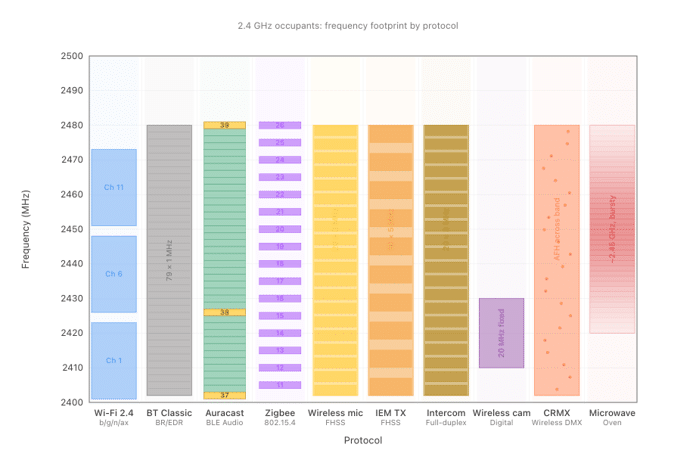
The dominant occupant of 2.4 GHz is Wi-Fi, and Wi-Fi is what people picture when they picture interference. Two facts about how Wi-Fi actually uses the band change that picture more than most people expect.
First, a Wi-Fi access point talks on one channel at a time. The 2.4 GHz band has room for only three channels that do not overlap; the ones labeled 1, 6, and 11. Any competent network uses only those three and assigns neighboring access points to different ones, so a single point occupies a single 20 MHz slice, not the whole band. In dense buildings, the current guidance from the major Wi-Fi vendors goes further: switch some of the 2.4 GHz radios off entirely, because too many of them crowding the same three channels mostly interfere with each other. The band is not a wall of Wi-Fi. It is, at most, three blocks of it, and increasingly fewer.
Second, Wi-Fi is bursty. It does not hold the channel open. It sends short frames separated by silence, and even a moderately busy network sits quiet on any given channel more than half the time. The number that matters is not whether Wi-Fi overlaps a frequency. It is how often Wi-Fi is actually transmitting there. That fraction, called the duty cycle, is a real variable we will explore.

Wi-Fi is the heavyweight, but it is not the only technology to consider. Depending on the building, you may share the band with several other systems, but you will rarely have all, or even many, of them at once. None behaves quite like Wi-Fi, but the two questions you ask are the same: what is each one’s duty cycle, and what is its frequency footprint. Answer those questions and most prove far less threatening.

Notice how Auracast™ compares, if you can even find its packets in the chart. It is a Bluetooth® Low Energy signal: narrow 2 MHz bursts, a fraction of a millisecond each, at a modest duty cycle. The technology we are examining is, by its own design, one of the gentlest and most spectrally polite occupants of the whole band. The standard we are worried about barely leaves a footprint of its own.
Importantly, most of these neighbors also transmit at lower power than Wi-Fi, and far less than the 20 dBm of a full venue Auracast™ transmitter like Auri™ by Listen Technologies. We’ll discuss in a later post why power, and especially power squeezed into Auracast’s narrow slices of spectrum, matters as much as how often a signal is talking. For now, just note that Auracast™ is rarely the weak voice in the room.
Put it all together and the band looks different from the reflex. It is crowded but not full. Wi-Fi uses a few wide slices, intermittently; a wireless video link can be heavy, but only when increasingly rare gear is in use; and the rest are narrow, brief, and polite. That leaves a great deal of room, in frequency and in time, for a system small enough and quick enough to slip through.

There is also an important trend: Wi-Fi is slowly abandoning 2.4 GHz. Newer Wi-Fi lives at 5 and 6 GHz, where there is far more room, and enterprise networks increasingly move public traffic there, thinning or even eliminating their 2.4 GHz footprint. The band Auracast™ has to share is getting quieter over time, not louder. We will come back to this in a later post.
Without question, the 2.4 GHz band is a challenge. In the worst venues, parts of it are genuinely hostile for much of the time, and a serious technology has to account for that rather than wish it away. In the next posts we will show why that hostility is a problem you can engineer around, and that Auracast™ does it in specific, verifiable ways.
It starts with making the audio data compact and resilient, the topic of the next post.
The Bluetooth® word mark and logos are registered trademarks owned by Bluetooth SIG, Inc. The Auracast™ word mark and logos are trademarks owned by Bluetooth SIG, Inc. Any use of such marks by Listen Technologies Corporation is under license. Other trademarks and trade names are those of their respective owners.
First, select the calculator type, USA (for Americans with Disabilities Act - ADA), California (for California Building Code), or Australia (for Australia's Disability Discrimination Act 1992). Enter the seating capacity and the number of minimum assistive listening devices required and the minimum number of neck loops will automatically populate based on the calculator type selected.